Stamped concrete services in Santa Maria CA - the look of stone on a solid base
Plain gray patio or a cracked walk? We pour and stamp concrete that looks like stone or brick, on a base built to hold.
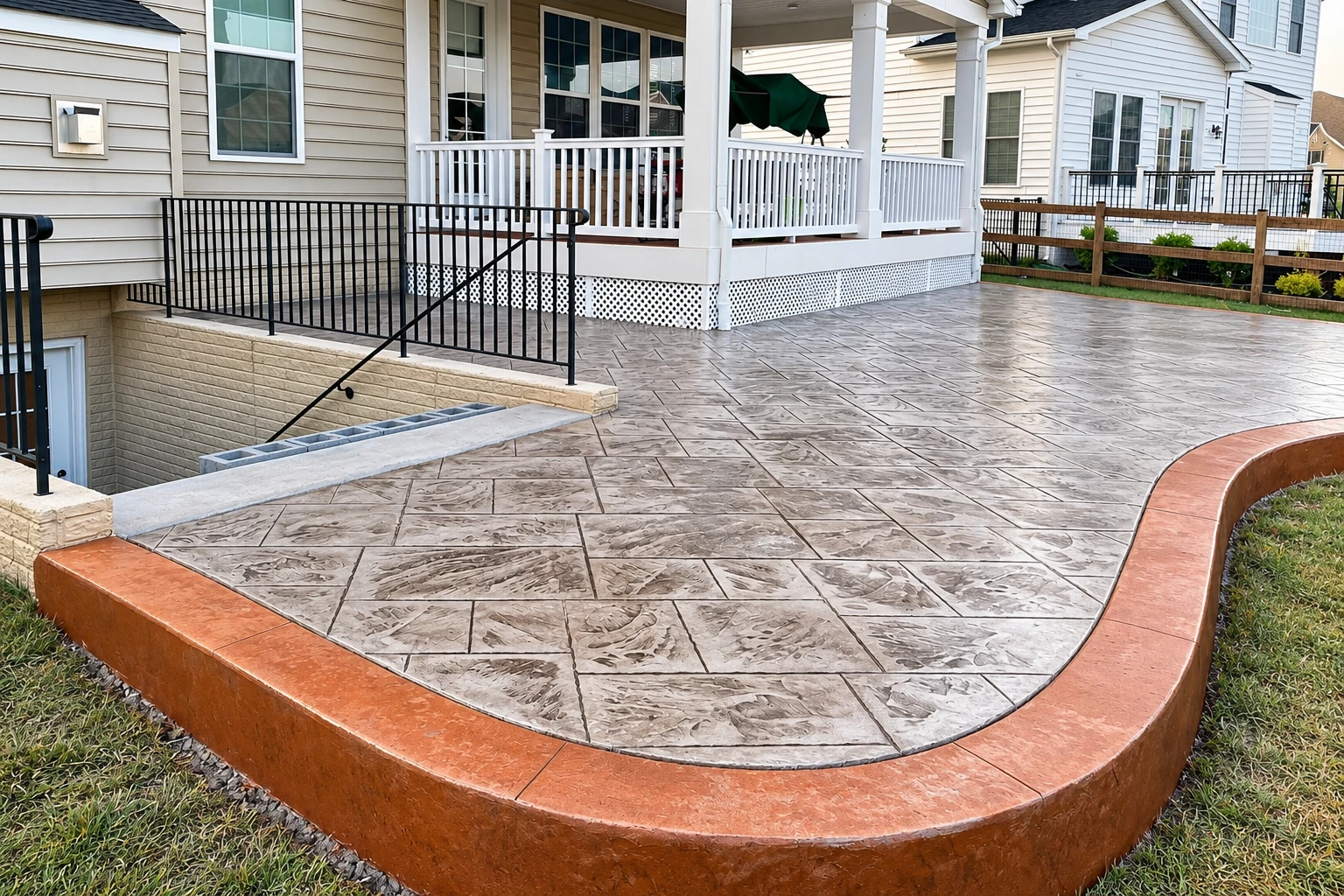
Stamped concrete is flatwork, the flat pours like patios, concrete walks and driveways, pressed with a pattern and colored so it looks like slate, brick or stone. Most calls we get for stamped concrete services in Santa Maria, CA come from homeowners with a plain gray slab they're tired of, or an old one that has cracked, sunk or started holding water.
Price moves with the size, the pattern and colors, any tear-out and how much base work the ground needs, and my written estimate puts each of those on its own line. The schedule turns on that prep, any permit and the curing, the wait while new concrete gains strength. If the budget's tight, I'd simplify the pattern before I'd cut the base, because nobody sees the base on day one, but it decides how the pattern holds up.
What our stamped concrete work includes
- I see every job myself. I come out to look at every job myself, and our own crew does the forming, pouring and finishing. We've been at it since 2017.
- Base dug out and packed. We dig out and pack the base under the slab instead of raking dirt level, because the steel inside a slab can't make up for weak ground under it.
- Pattern and color settled first. We go over slate, brick and stone patterns with you, and I'll tell you whether the color goes through the whole mix or just the surface.
- Joints laid out ahead of time. Control joints are cuts that give the slab a planned place to crack, so we lay them out along the pattern and cut them on time.
- Poured and cured right. We schedule the pour so we're not finishing in midday heat, which leaves a weak, dusty top later, and we keep you off it until it's cured.
- Licensed and insured in California. California counts forming, pouring and finishing flatwork as concrete contractor work, and we're licensed and insured. Unlicensed hands can only take jobs under $1,000 that need no permit, working alone.
What goes wrong with stamped slabs
| Problem | What it looks like | Usual fix |
|---|---|---|
| Sunken or settled slab | What it looks like: Sections dropped below the rest, edges lifting or tipping | Usual fix: Tear out, dig to firm ground, pack a new base |
| Water pooling by the house | What it looks like: Puddles after watering, or water running back toward your foundation | Usual fix: Re-pour with the slab falling away from the house |
| Cracks across the pattern | What it looks like: Cracks wandering through the stone pattern instead of along joints | Usual fix: Replace the section with joints laid out first |
| Dusty, flaking top | What it looks like: Surface powders, chips or flakes, with color wearing off in spots | Usual fix: Remove and re-pour, finished and cured on schedule |
New stamped slab or a smaller fix
- Full tear-out and pour. This suits a slab that has sunk, cracked across the middle or tips water toward the house, because a new pattern on a bad base won't stay put.
- Stamp where it shows. Stamp the patio or front entry and keep side yards and the garage floor a plain broom finish, the swept texture that gives grip, so the money goes where you look.
- Fix one section. If one area went bad and the rest is sound, we can cut it out and re-pour it, though new color rarely matches old exactly. I'll tell you if that's all you need.
How a stamped job runs
- You reach out. Tell us roughly how big the area is and what you have in mind, and we get back to you to set a time for me to come out.
- I look at the site. I measure, check the ground and the access, and see whether the area meets the curb, since that can bring in a city permit.
- Written estimate. You get a written estimate that lists each part of the job, base work and color method included, so nothing is buried in one total.
- Permits and forms. Once you say go, we file any permit with the city or county and set up inspections, then set the forms and walk them with you.
- Pour, stamp and cure. Our crew pours, stamps and cuts the joints, then lets the slab cure before you use it, and we clean up before we leave.
What keeps a stamped slab looking right
Most of what keeps a stamped slab sound is done before you see it, in the base, the joints and the cure. Your part is to stay off it until we say it's ready, and to call me if water starts pooling where it didn't before.
We're based in Santa Maria and work for homeowners and small property owners across the Santa Maria Valley, from southern San Luis Obispo County down to Lompoc and Buellton, including Orcutt and Nipomo. Call (805) 268-7763 or send the form to ask for an estimate.
Tell us what you want stamped
Send the area's rough size, whether it meets the curb and the look you want. We reply within one business day to set a time to come out.
(805) 268-7763- Free estimate at your property
- Written out line by line
- No obligation to go ahead
Stamped concrete questions we hear
How much does stamped concrete cost in Santa Maria?
Installing stamped concrete across the US usually costs about $26 to $31 per square foot, and that's a national figure for the installed work, not our price. Your number depends on the size, the pattern and colors, any tear-out and the base work, and my written estimate lists each of those.
Will my stamped concrete patio crack?
Some cracking is normal on every slab, even one designed and built right, so plan on a few rather than expect none. What we control is where they go, because the joints we lay out give cracks a planned line instead of letting them cut across your pattern.
How is the color added to stamped concrete?
Color goes in one of two ways, through the whole mix or on the surface. Integral color adds iron oxide pigment to the concrete during mixing, while a color hardener is made to color just the top. Ask which one any quote uses, and I'll tell you which I'm planning and why.
Do I need a permit for stamped concrete at my driveway approach in Santa Maria?
Yes, Santa Maria requires an encroachment permit for any work in the public right-of-way, usually a strip several feet wide along the curb that holds the sidewalk, parkway and driveway approach, and the city's standards decide what can go there. Away from the curb, the city's Building office at 805-925-0951, ext. 2241 can tell you if you need one, and we handle any permit the job calls for.